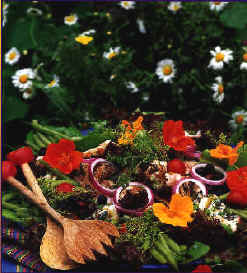
Lovely purple flowers grace garden sage and lavender, while mint blooms in shades of
lilac, and rosemary blooms in delicate shades of blue and white. Chive's lovely
star-shaped flowers range from bright pink to lavender hues, while cilantro's white umbels
look like lace. Arugula's white flowers taste peppery, and Mexican mint marigold's
brilliant golden blossoms sparkle when placed in bottles of vinegar.
Remove the small,
individual yellow flowers from large umbels of dill and fennel or use the whole head as
herbal embellishment, and take advantage of basil's tender (and prolific!) emerging seed
spikes in assorted colors and fragrances for garnishes as well.
Sprinkle any of these aromatic herb blossoms over salads or soups, cheese spreads and
dips, rice or pasta dishes, or herb-flavored butters. Let herb blossoms colorfully accent
salads, adding extra flavor too!
Use lemon verbena's tiny cream-colored citrus-scented blossoms or pineapple sage's scarlet
plumes for fragrant garnishes for sorbets, ice cream, cakes, and refreshing punches. Oh!
and don't forget to place a few lavender spikes in a glass of champagne for color and for
its unforgettable flowery essence.
I grow other flowers in my cottage garden, not only for beauty, but for use as edible
garnishes also. Remember, any flower eaten should be grown organically without the use of
pesticides (unfortunately, most florist-purchased flowers have been chemically treated).
Do not sample flowers unless you are certain that they are indeed edible
Gather flowers early in the morning and store them in the refrigerator in an airtight
container until ready for use or in a bouquet in a vase of water. Naturally, picking
delicate flowers in the middle of the day will cause them to wilt on the platter! Petals
may be removed and sprinkled individually or entire blossoms may be used. Remove the
pistils and stamens from larger flowers to prevent bitterness.